

How to Throw a Block Party
It's easier than you might think.

Quick query: I’m looking for parents who feel generally overwhelmed by their family life schedule, particularly around kids’ sports and intensive extracurriculars. (Although I hope you are getting a lil break this summer!) If you are interested “beta testing” a exercise I’m creating for my book to help families break out of what I call “the kids activity doom loop” and make time for other things, email me at katherine at thedoubleshift dot com.
For the How to Find Your People Club this month, I’m revising and updating a post I wrote last summer about block parties. My book research has fully convinced me that neighborhoods offer some great opportunities for connection. I am now even more sold on the idea that simple, annual block parties can be a powerful basis for a strong community. A block party involves planning, anticipation, and collaboration in the lead-up, along with in-person socializing and a shared experience for residents to bond over afterward. While several pieces of research support this idea, one compelling study published in the Journal of Community Psychology of two small Italian towns found that one had a much stronger sense of community than the other. The only difference researchers could find was that the community-minded town had an annual celebration that involved putting on a play where about half the residents participated, while the other town had no similar participatory annual celebration.
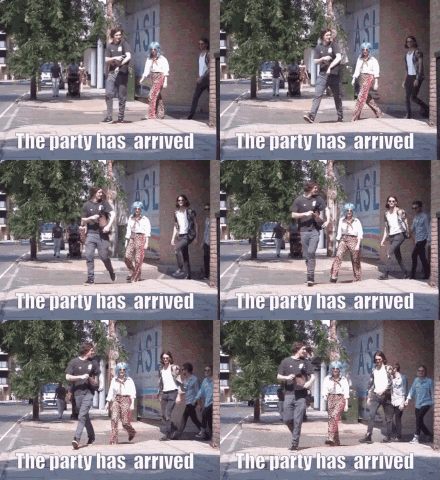
Last summer I volunteered to co-organize a neighborhood block party. My not-too-lofty goal was for people to enjoy themselves and to help provide an opportunity for people to get to know each other better in person, which is a key factor in building trust over time. My family will likely live in our current house for at least 10 more years, so I’m thinking about the long game.

Based on both my general research and my personal experience, here’s my advice on pulling it off.
Recruit a co-leader: Share the planning load with someone outside of your household. Not feeling like everything comes down to you can take the pressure off making the event a success. I paired up with my neighbor Jordan, and she and I proved to be a great match. Even though we barely knew each other when we started, we divided tasks well and had fun during our planning meetings drinking wine at her kitchen counter.
Keep the scope modest: Especially if this is a new event for your neighborhood, keep your ambitions in check. There’s no need to foot the bill for anything extravagant in terms of food or entertainment. We provided hot dogs and popcorn and told everyone to bring some food and drinks to share. It worked out fine, and Jordan and I split the hosting cost, and it came out to about $36 each. Set the bar so that it doesn’t feel like a burden to pull off in future years or that other volunteers could sub in to take charge if needed.
Ask people for help: We recruited other neighbors who we knew were into the idea to help with setup and clean up, and to lend us folding tables and a bounce house. It made the whole process easier to have more hands on deck and asking for small favors like this immediately builds up a neighbor reciprocity culture.
Spread the word: We decided to put flyers in people’s mailboxes along three streets and hang some flyers on telephone poles. One of the most interesting aspects of planning this party was having very little idea of who would show up. We didn’t have contact info for most of the people we invited. We attempted to get people to sign up to bring things for the potluck by printing a QR code linking to a Google sheet, but almost no one used it. People still came and the potluck contributions worked out just fine!
Think about location: If possible, block your street off from traffic (you sometimes need a permit for this but we didn’t bother) or put the festivities in a place where kids can roam a bit free (even someone’s backyard) without having to worry about cars.
Consider an ice breaker: Definitely put out name tags, but it can help to have a prompt to get conversations flowing if most people don’t know each other yet. You can make a little sign or tell people when you greet them that “we’re asking people to share their favorite thing to do in [OUR TOWN] during the summer.” Or “Share what your favorite dessert is,” or “See if you can find out who’s lived on the block the longest.”
Use the block party as an opportunity to build contact lists: If your neighborhood doesn’t have a listserv, Whatsapp group or you generally don’t have contact information for people, a block party is a great time to gather it. Consider putting out sheet where people can share their email or phone number for future communications.
I LOVE this handy one-pager from Block Party USA that shows the positive ripple effects of the simple tradition of a block party:
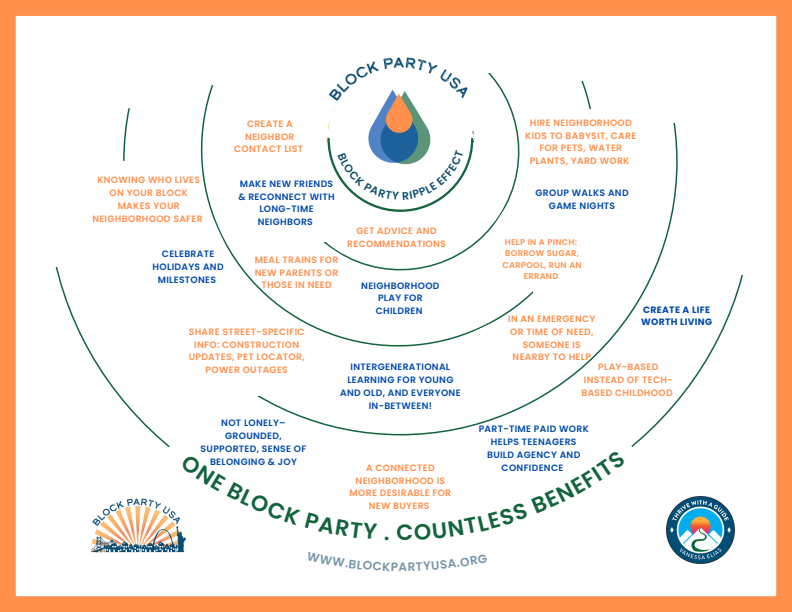
They are tons of resources on their site, including invitation templates and a one-pager on throwing a block party, so check it out!
I’m pleased to share that our 2024 summer block party was a success. And I’ll let you in on TWO secrets:
1) This was no more work than putting on a children’s birthday party. I repeat, if you can throw a child’s birthday party, which most parents do at some point, you can throw a block party.
2) The type of people who come to a block party are the type of people who want to know their neighbors. Everyone who showed up was friendly. A win!
Jordan and I are keeping the tradition going in 2025! Based on what we learned last year, we are planning to do a few things differently this year. For example, we did it late afternoon in August in North Carolina and it was REALLY hot. Too hot. We had some fans going, but I think we are going to opt for a fall date this year. Additionally, I think we are going to plan a few ice breaker conversation topics for folks. Also, if anyone have tips for us about how to get people to sign up for what they are actually going to bring for the potluck part, I’m all ears! It all worked out fine, but not having email addresses for everyone made signup and RSVPs pretty hard.
Alright HTFYP Club members, I want to hear from you. Does your neighborhood have annual traditions like block parties? Have you thrown or attended one? Are you interested in organizing one yourself?
Also! Club member Jeanne will be joining us on Zoom June 25! She read a version of this newsletter last year and used it to successfully recently throw a block party! We’ll hear what she learned and we can ask her questions about how it went. If you’d like to be a part of this, become a member of the How to Find Your People Club. It makes my work possible.
This was a great post. I commend you for taking on this task of having a block party. We live in an HOA which has been one with lots of personality and power wars in the past. Thankfully, the old guard who wanted power and control are mostly no longer exerting control because they got old. (Not nice to say, but true.) The neighborhood of fewer than 100 homes has new blood and they want to get together and get to know others. They also are more community minded in the way they want to help others. We now have “happy hour” in the drive ways of the homes of hosts once a month where you just bring your own chair and drink and food to share if you wish. They happen for an hour and half (although some stay a bit longer) on Fridays. It has been a great community builder. The social committee for the HOA plans them and sends out the notice. We then have three big socials during the year: 1)a summer barbecue out side where we have a corn hole contest. It is pot luck with assignments for the type of food made by the street on which one lives; 2) a fall Oktoberfest event also outside which features a chili cook off; 3) the winter social at Christmas time that is held in a home where we bring light snacks and/or wine or other drinks. Again, the social committee that folks sign up for once a year plans all the events.
Our cul de sac has a Halloween dinner, where we block the street with a table with candy bowls from our houses and eat dinner together a little farther back. No one plans what food to bring, it is strict potluck! It is one of the nicest parts of living on our street.