

Why You Should Throw a Block Party
Let’s make being a good neighbor cool again.


For many years when I lived as a renter in New York City, I was a pretty mediocre neighbor. I lived in apartments where I didn’t even know the names of the handful of other people in my building. The extent of my neighborliness might have been to silently put a piece of misdelivered mail in its proper place. Turns out, I wasn’t an anomaly. According to Pew Research, 23% of adults under 30 don’t know a single one of their neighbors.
Homeownership in my thirties has definitely made me more interested in investing in neighbor relationships, but for years I wasn’t sure exactly how to do it. For some, COVID connected neighbors better with people checking on each other, yard hangouts, and childcare pods. But for us, dealing with the overwhelm of our pandemic twins, it probably slowed us down.
Many of us want strong relationships with our neighbors. I love that the importance of being a good neighbor was a recurring theme at the DNC, and one of Tim Walz’ touted credentials was that he was the kind of guy who would help push you out of a snowbank. These are the kinds of relationships we need with people who live close to us: no matter how much you love someone, you can’t help them out when they have car trouble or a power outage if you live across the country. Investing in relationships with our neighbors may also be one antidote to our loneliness epidemic. According to a 2006 study published in the Journal of Community Practice, one of the biggest factors that influence our satisfaction with a neighborhood is whether we trust our neighbors. However, when deciding where to live, there’s no Zillow rating for “trust,” and most of us don’t have a framework for thinking through what it would take to be a part of—or build—a trusting community within a neighborhood.
Enter the block party.
My street has gotten some new neighbors this spring, two sets of 30-something first-time homebuyers, including my friend and former Double Shift editor, Anita Rao. A longer-time resident hosted impromptu welcome drinks for the newbies and I got to talking with Jordan, who’d moved in with her wife about two years ago but I’d only met once or twice. Our street had a long tradition of a block party, but it had faded in and out a bit during the pandemic. The last organizer was looking to pass the torch. Jordan and her wife had agreed to take it on some months ago but weren’t sure where to start.
In my work life, I’ve been doing a lot of reading about community building, and have identified neighborhoods as one area that provides ripe opportunities for connection. My research shows me that regular traditions, even if only yearly, can be a powerful basis for strong communities. Even something as simple as a block party involves planning, anticipation, and collaboration in the lead-up, along with in-person socializing and a shared experience for residents to bond over afterward. While several pieces of research support this idea, one compelling study published in the Journal of Community Psychology of two small Italian towns found one had a much stronger sense of community than the other. The only difference researchers could find was that the community-minded town had an annual celebration that involved putting on a play where about half the residents participated, while the other town had no similar participatory annual celebration.
So I volunteered to co-organize the block party. My not-too-lofty goal was for people to enjoy themselves and to help provide an opportunity for people to get to know each other better in person, which is a key factor in building trust over time. My family will likely live in our current house for at least 10 more years, so I’m thinking about the long game.
Based on both my general research and my recent experience, here’s my advice on pulling it off.
Recruit a co-leader: Share the planning load with someone outside of your household. Not feeling like everything comes down to you can take the pressure off making the event a success. Jordan and I proved to be a great match and even though we barely knew each other when we started, we divided tasks well and had fun during our planning meetings drinking wine at her kitchen counter.
Keep the scope modest: Especially if this is a new event for your neighborhood, keep your ambitions in check. There’s no need to foot the bill for anything extravagant in terms of food or entertainment. We provided hot dogs and popcorn and told everyone to bring some food and drinks to share. It worked out fine, and Jordan and I split the hosting cost, and it came out to about $36 each. Set the bar so that it doesn’t feel like a burden to pull off in future years or that other volunteers could sub in to take charge if needed.
Ask people for help: We recruited other neighbors who we knew were into the idea to help with setup and clean up, and to lend us folding tables and a bounce house. It made the whole process easier to have more hands on deck and asking for small favors like this immediately builds up a neighbor reciprocity culture.
Spread the word: We decided to put flyers in people’s mailboxes along three streets and hang some flyers on telephone poles. One of the most interesting aspects of planning this party was having very little idea of who would show up. We didn’t have contact info for most of the people we invited. We attempted to get people to sign up to bring things for the potluck by printing a QR code linking to a Google sheet, but almost no one used it. People still came and the potluck contributions worked out just fine!
Think about location: If possible, block your street off from traffic (you sometimes need a permit for this but we didn’t bother) or put the festivities in a place where kids can roam a bit free (even someone’s backyard) without having to worry about cars.
I’m pleased to share that our 2024 summer block party was a success. Even though it was hot and plenty of people were out of town because it was August, a fun time was had by all. And I’ll let you in on TWO secrets:
1) This was no more work than putting on a children’s birthday party. I repeat, if you can throw a child’s birthday party, which most parents do at some point, you can throw a block party.
2) The type of people who come to a block party are the type of people who want to know their neighbors. Everyone who showed up was friendly. A win!
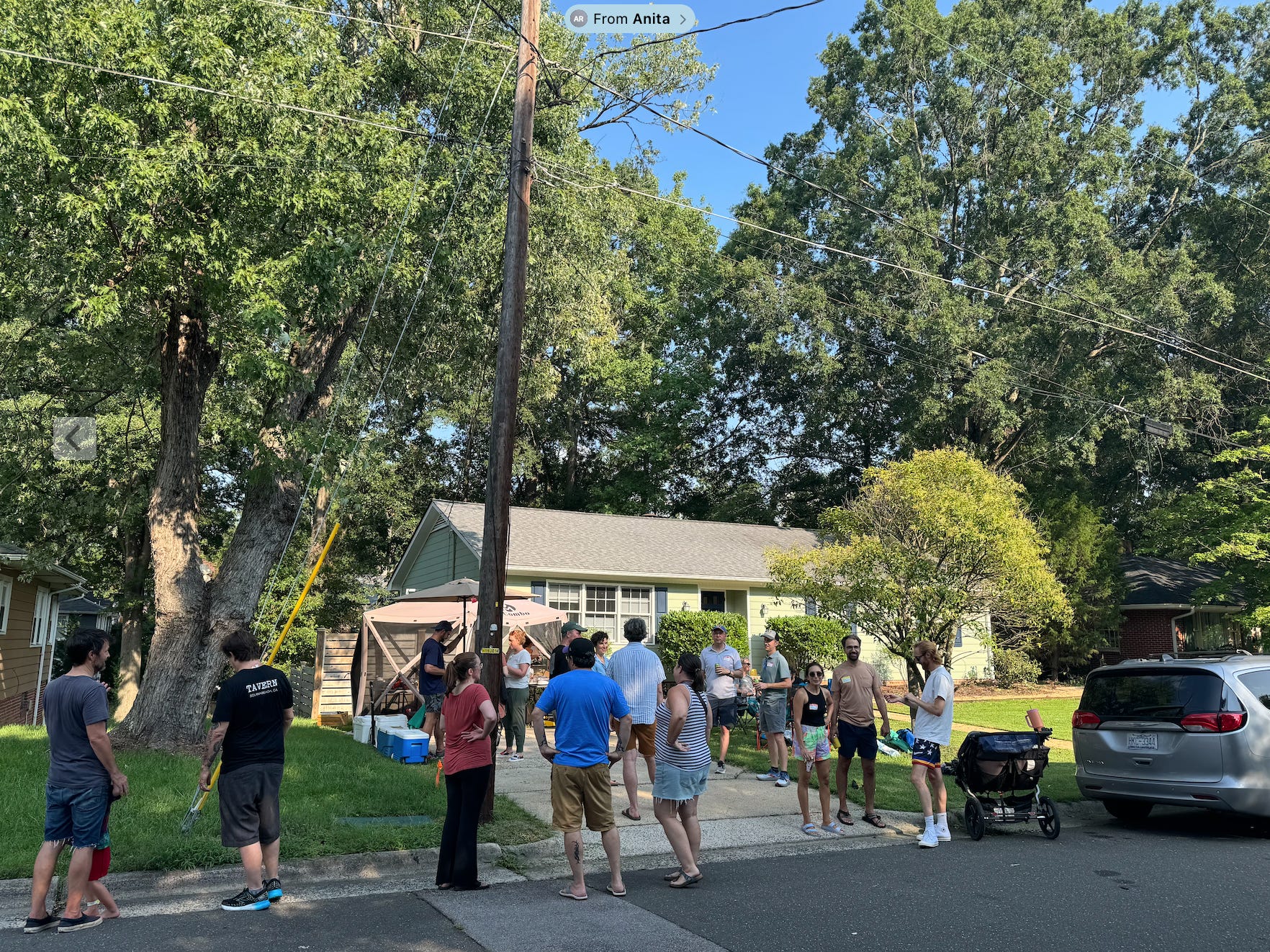
I enjoyed having some fun points of connection with others that I’ve previously only waved to, like another mom of three boys who lives around the corner and I learned that she grew up in the same city as me and graduated high school the same year. I hadn’t talked to her much because our kids don’t go to the same school, even though I've walked by her house a million times. I was pleased to get to know another nearby family of younger twin boys and am now planning to give them some hand-me-down clothes. One neighbor who I’d only talked to while trick-or-treating at her house was very friendly, defying some preconceived notions I had about her based on her political yard signs. Jordan and I are already planning to do it again next year.
Alright Double Shifters, I want to hear from you. What are your neighbor relationships like? Are you interested in trying to get to know your neighbors better?
Right after moving into a new apartment in a new city, I wanted an excuse to introduce myself to the next-door neighbors. So I baked some cookies and knocked on the door. (Having baked goods in hand always makes me feel less awkward.) The neighbor couple invited my husband and I to an event, where we met more friendly people, and then they invited me to join their book club. I made some wonderful friends and attended that book club for 7 years until we moved away.
We've been in our current home for about a year, and we make a point to do small things like stopping to say hi, pulling their trash cans in from the curb, etc. But I love the idea of a block party to break the the ice with more folks on our street.
💯! I wrote a story a while back called, "I Was Losing Faith in Humanity, So I Threw a Block Party." I firmly believe that building connections with our neighbors is one of the best (and most accessible) ways to prepare for an uncertain future.
If a natural disaster hits, or another pandemic is declared, or gun-wielding white supremacists invade my city, I want to know the people directly around me. I want to have an idea of who has what resources and skills.
Ok, so maybe this is a darker take on the neighborhood block party, but hey, there’s no reason we can’t have some fun while preparing for the end of the world!